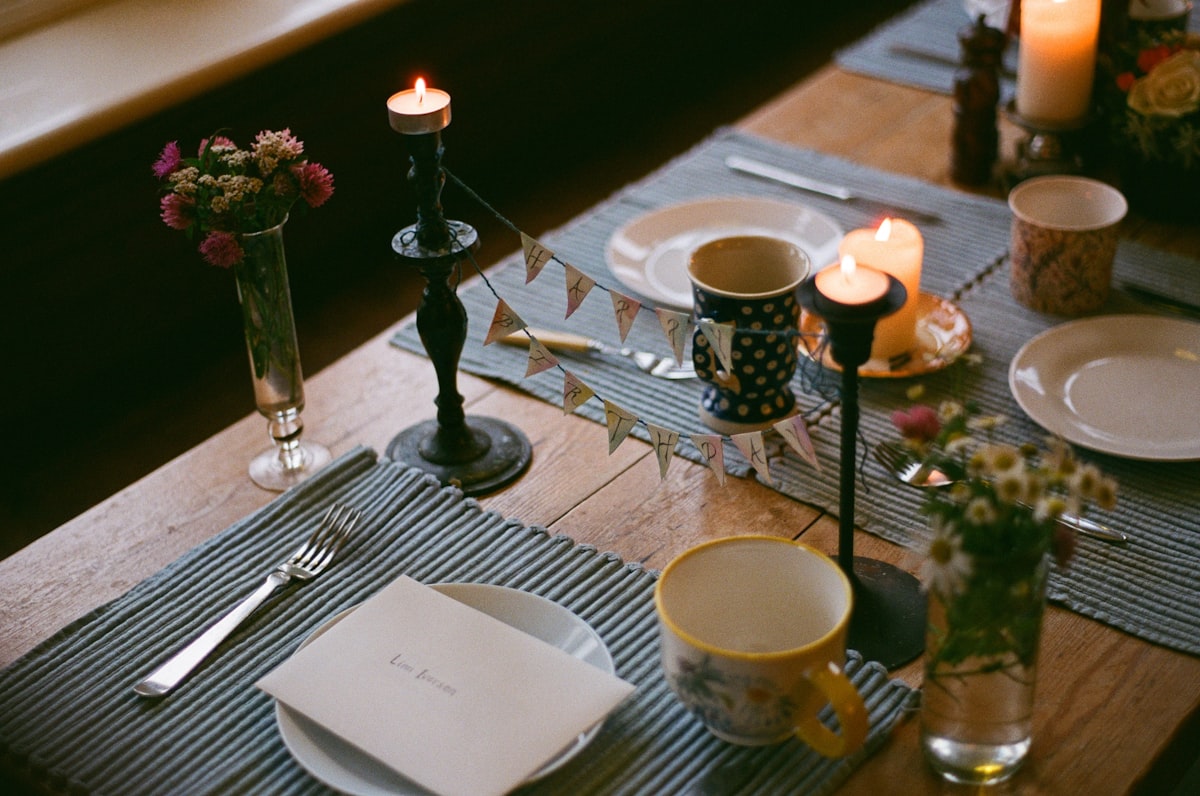
The oldest cookbook I own has another woman's handwriting in the margin beside the roast chicken, in faded ballpoint: too much for the Dohertys, halve it, they don't eat. I have never met the Dohertys. I bought the book for fifty cents at a Lisbon flea market and I keep it for lines like that, the small print of somebody else's hospitality. I thought of her last Saturday, halving a recipe of my own, because six people were coming to ours and going out was off the table, in both senses.
We are, it turns out, fashionable. Eater called 2024 the year of the dinner party, and the years since have proved it right. On Evite, searches for "dinner parties" jumped 148 percent in a single year, a figure the company reported to Axios. The reason given is almost always the bill. In the United States, restaurant prices have climbed faster than grocery prices every year for a while now. Food away from home rose 4.1 percent in 2024 and 3.8 percent in 2025, while food at home rose 1.2 and then 2.3 percent, according to the US Department of Agriculture. The gap sounds small. Stacked up over four or five years, it is the difference between a night out and a number on the receipt you actually noticed.
The kitchen turned out to be the cheapest room in the house. A ribeye you cook yourself starts at about 25 dollars a serving, under a chain steak that opens north of 30 before you have ordered a glass of anything, per a tally in Food Drink Life; the home cut runs to 32 at its priciest, and even then you are buying the groceries, not the evening. The same piece cites HelloFresh finding that 85 percent of Americans who plan to cook more blame the economy. So we host. I host badly, with bread that rarely rises, and nobody has left yet.
But money is the tidy explanation, and I distrust tidy. The deeper number is lonelier. Between 2003 and 2024, as Derek Thompson calculated from the American Time Use Survey, the time people spent hosting or attending a social event fell by half, and for those aged 15 to 24 it fell by about 70 percent. In 2023, only 4.1 percent of Americans had been to or hosted a party on a typical weekend. We did not just get priced out of the restaurant. We got out of the habit of each other.
Which is why the new codes are so earnest. There are assigned courses now, you bring the starter and you mean it, and "table captains," and dress themes, and phones face-down in a bowl by the door. Resy reported that one in three people who ate at a communal table last year made a new friend, and Fox News, citing the same retrospective, put the share who met a romantic partner at one in seven. My grandmother would have called that a Tuesday.
Here is the part that undoes the neat version. The price gap is already closing. In Britain, restaurant inflation now runs below grocery inflation, and the American gap is forecast to narrow again. The economic excuse is quietly expiring, and we are still setting the table. It turns out we did not want cheaper. We wanted closer. I will halve the recipe again next Saturday, and I will not tell you it was about the money.