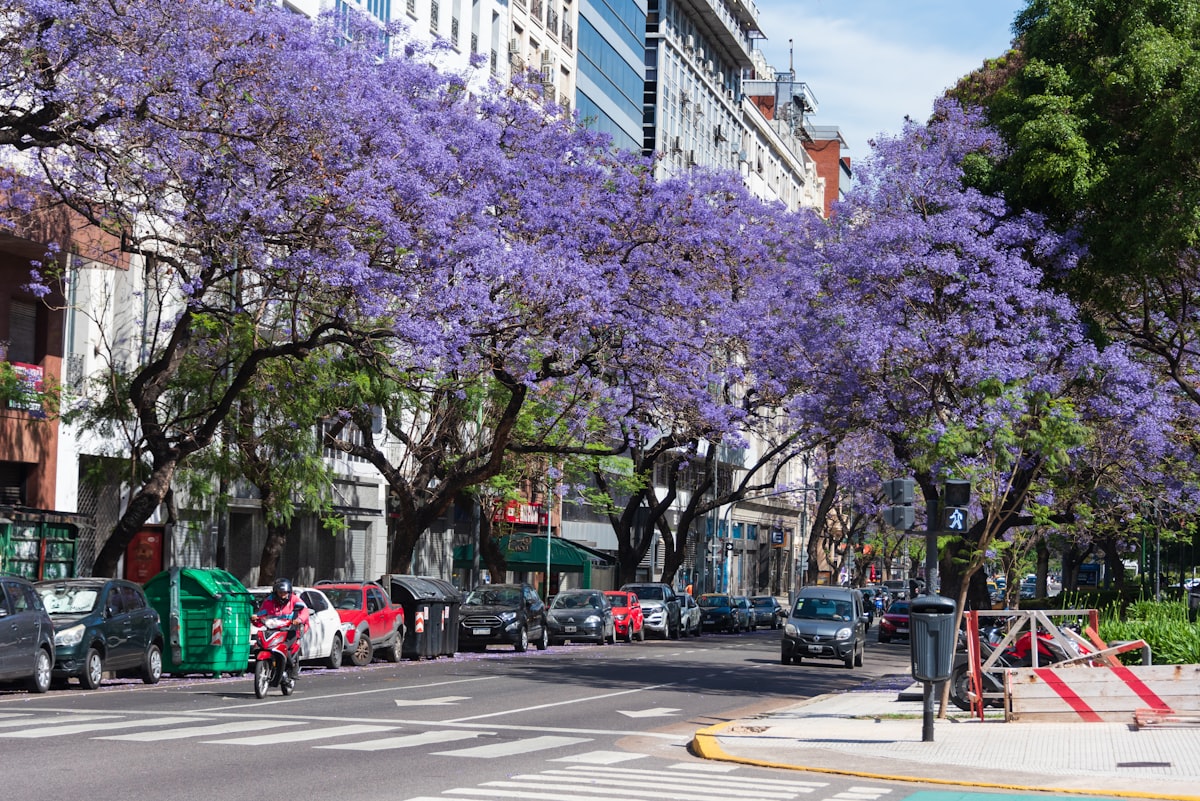
The strange thing about the jacaranda is that it flowers naked. Sometime in early November, along the Avenida del Libertador, the trees drop most of their leaves and then, on the bare gray branches, open all at once into a violet so total it changes the color of the light under them. Nothing shades the flowers. That is essentially the city government's own term for it, flowering without green leaves. You walk beneath a canopy that should be green and is instead the color of a bruise healing, and the sidewalk fills with fallen bells you cannot help but step on.
This is a northern hemisphere reader's counter-season. In the third week of November, when Madrid and Chicago are pulling coats out of storage, Buenos Aires sits in the last stretch of spring, highs near 25 Celsius (77 Fahrenheit) and evenings that ask for a light jacket, the heavy summer humidity still a few weeks off. For a reader in Sao Paulo or Sydney this is simply spring arriving on time. For one in the north it is the same calendar run in reverse, a warm season to borrow while your own is closing.
The jacaranda is not from here, which is the whole point. It is native to the yungas, the cloud forests of Argentina's northwest, up in Tucuman, Salta, and Jujuy, and it was carried down to the flat river city by Carlos Thays, the French landscape architect who ran the parks department from 1891 to 1913 and planted the Buenos Aires most people think of as simply given. He brought the jacaranda and the tipa, another northern tree, out of the north and set them along the avenues, and the tree that now reads as the most porteno thing in the city, porteno being the word for a native of this port city, is a provincial import that never blended all the way in. It undresses before it flowers, the bloom opening on bare or nearly bare branches, and in this gridded river city that habit looks less like botany than like someone who never learned to dress for the room. The out-of-placeness is the spectacle.
The numbers are municipal and worth knowing. The city's tree census counts 18,922 jacarandas, 13,872 of them on sidewalks and another 5,050 in the parks and plazas, which makes it only the fourth most common tree in the public space, behind the American ash, the plane, and the linden. It does not need a majority. In 2015 the city legislature named it the distinctive tree of Buenos Aires, and for the three weeks it matters, that is not sentiment.
The government lists its densest corridors plainly: Cabildo, del Libertador, Cordoba, Corrientes, San Juan. Those run you straight through Belgrano, Recoleta, and Palermo, where the show is thickest, along the Barrancas de Belgrano, a park in Belgrano, and the paths of the Parque Tres de Febrero. Do not chase a single famous tree. The jacaranda is a street tree, at its best by the block, and the reward is walking a long avenue until the purple stops being a photograph and becomes the weather.
Argentine children learn a Maria Elena Walsh song about it, "Cancion del Jacaranda," in which a drawing is sketched on the sidewalk and the wind then sweeps it away. It is a children's song and it is also accurate. The bloom does not last. By the second week of December the branches have gone green and ordinary again, and the whole thing reads, correctly, as borrowed.