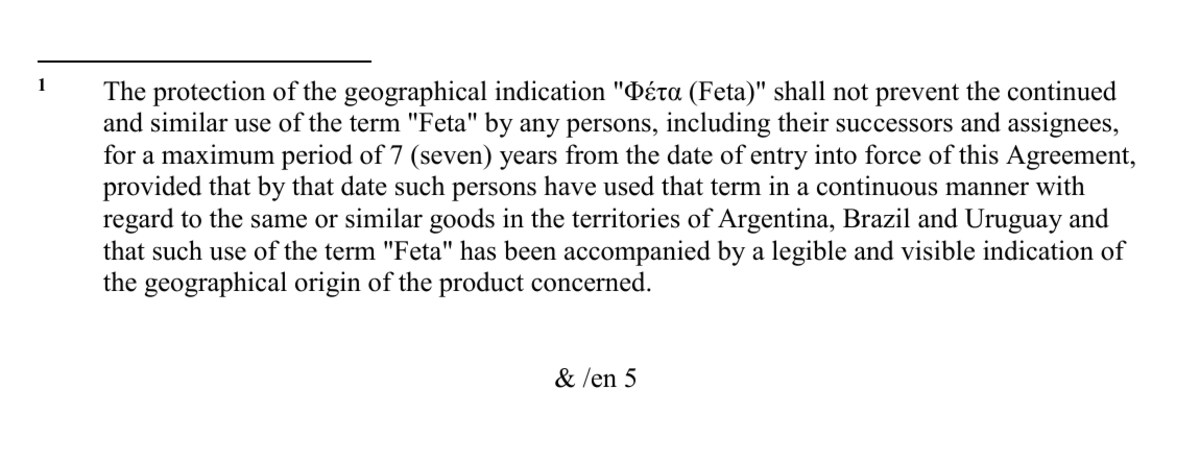
There is a footnote in the European Union's new trade agreement with Mercosur, the South American bloc of Argentina, Brazil, Paraguay and Uruguay, that reads like a boundary settlement. It hangs off the entry for Φέτα (Feta), Greece, cheeses, and it gives anyone already selling feta in Argentina, Brazil or Uruguay "a maximum period of 7 (seven) years" to stop using the word. That clock started on 1 May this year. Not quite four years earlier, the EU had taken one of its own member states to court for allowing much the same thing.
That was Denmark. On 14 July 2022 the Court of Justice held that Denmark had breached its obligations by not stopping Danish dairies from putting "Feta" on cheese that did not meet the Greek specification. Denmark's defense was that the cheese was bound for countries where nobody protected the name, so European law had nothing to say about it. The Court disagreed, reading the obligation to cover products "produced or marketed" in a member state, and ordered Denmark to pay four fifths of the Commission's costs. Strictly these are different questions, one about a member state policing its own dairies, the other about South American producers in their own markets. But set the two side by side. The EU went to court over that word at home while agreeing a seven-year runway for it abroad.
That is the thing worth understanding, and it is not what the system says about itself. The idea is a name tied by law to a place, either as a protected designation of origin or, on looser terms, a protected geographical indication. At the end of July 2026 I filtered the EU's register, eAmbrosia, for the names it lists as Registered. There were 3,712. The Commission rounds that to "more than 3,700", puts annual sales above 75 billion euros, and reckons these names make up 15.5 percent of EU agri-food exports. Since a new regulation took effect in May 2024, foods, wines and spirits sit in one register, kept by the EU's intellectual-property office in Alicante. It is a tidy piece of machinery. What it is for is leverage.
The exceptions run to 36 names, on clocks or a permanent list of firms
Mercosur is where you can watch it happen, because the paperwork is public. The two sides signed on 17 January 2026 and the interim agreement began to apply provisionally on 1 May, at which point, in the Commission's words, "Mercosur countries will start protecting 344 EU Geographical Indications (GIs) as of 1 May, banning imitations as well as misleading terms, symbols, flags or images." That happened while Parliament's consent was suspended: on 21 January, by 334 votes to 324 with 11 abstentions, MEPs asked the Court of Justice whether the agreement conforms to the treaties. Trade is an area where the EU, not its member states, holds the power to act, so the names are protected abroad before Parliament has voted on the deal protecting them.
The Commission's summary of the deal says protection applies "for most listed names, with only limited exceptions for prior use or prior rights." So I counted the exceptions. The document is the annex to the Commission's proposal for the decision concluding the agreement, received by the Council on 3 September 2025, and I went through the footnotes of its Annex 13-B name by name this month. That is the pre-signature version. I could not check it against the text now in force, because EUR-Lex puts a bot-check in front of the Official Journal, which is its own comment on how public a published law is. The name list is the right one, though: my count comes out exactly on the four national figures the Commission publishes for this deal, 63 French names, 59 Spanish, 57 Italian, 36 Portuguese. The total is less tidy. I get 346 where the Commission says 344 and cannot account for the two, and its own tally is not fixed either, appearing elsewhere as more than 350. The national match covers the list. It does not cover the footnotes, which is where I counted.
The clocks cover 30 EU names, licensed to somebody else for five, seven or ten years: Champagne for ten years across all four Mercosur states, including for "Método / Méthode Champenoise"; the vine variety "Prosecco" for five years in Argentina and Paraguay and ten in Brazil; Prosciutto di Parma for seven in Brazil, as "Presunto tipo Parma"; then Pecorino Romano, Roquefort, Gorgonzola, Comté, Cognac, Sherry and the rest.
Because nine names take a different route. Parmigiano Reggiano's footnote is three words, "Article 13.35(8) applies," and so are those for Gruyère, Fontina and Queso Manchego. They point to Annex 13-E, "Mercosur state parties' list of prior users," which is not a schedule of years but a roster of companies: 22 blocks of them, one per country and term, running to more than 500 listings. Under ARGENTINA, term PARMESANO, there are 33, including Mastellone Hnos., Milkaut and Molfino Hnos., three of the firms that also appear on the Argentine list for Gruyère. The entitlement carries no end date, though it is not unconditional, since the annex gives every listed firm twelve months to meet the conditions in Article 13.35(8). Three names sit on both lists, so the sets overlap rather than add.
Between them the clocks and the roster cover 36 distinct names, roughly one in ten of the 344, so "limited" is fair enough. The interesting part was never the share. It is which names, and whose clocks: Grana Padano got seven years for "Grana" in Argentina and a place on the roster, while Parmigiano Reggiano got the roster and no clock at all. Both are northern Italian hard cheeses, and the difference between them is not a difference in the cheese.
Washington put the EU on its intellectual-property watch list this year
None of this runs one way, which is what gets lost when the story is told as Europe defending its patrimony. On 30 April the US Trade Representative added the European Union to the watch list in its annual Special 301 report, the survey Washington uses to name countries it considers delinquent on intellectual property. The language is blunt: "The EU GI agenda remains highly concerning because it significantly undermines protection of trademarks held by U.S. producers and imposes barriers on market access for U.S.-made goods that rely on the use of common names, such as parmesan or feta." As IPWatchdog reported, that is the EU's first appearance since 2006, though pharmaceutical and digital legislation are cited alongside the food names, so it is not solely a cheese quarrel.
Foreign courts have not been uniformly obliging. In March 2023 a US federal appeals court held that gruyere is generic in the United States, as a matter of law, leaning partly on the Food and Drug Administration's own standard of identity for "Gruyere cheese," which imposes no geographic restriction. And when the EU concluded its trade agreement with India in January, it did so with no geographical-indication chapter, the names split into a separate agreement that remains unconcluded. The bloc does not always get the annex.
Where it does, Mercosur is no aberration. New Zealand's agreement with the EU, in force since May 2024, protects close to 2,000 EU names and provides, in the New Zealand government's summary, that protection "will not prevent prior users of the terms 'Gruyère' or 'Parmesan' from continuing that use," provided they used them in good faith beforehand and label the true origin. The same grandfathered class of prior users, on the other side of the world.
There is an older irony underneath. At the World Trade Organization, where extending this kind of protection has been deadlocked for two decades, Argentina and Paraguay are listed among the countries opposing it, alongside the United States, Australia and New Zealand. Both are now bound by the Mercosur annex. The multilateral route has gone nearly unused: under the Geneva Act of the Lisbon Agreement, which the EU joined in 2019, the Commission's 2022 filing decision covers 18 names. Eighteen, against 344 in one bilateral deal. Bilateral is where the bargaining happens, so bilateral is where the names go.
Cyprus registered one name in two languages, and its own farmers went to court
I have spent most of my working life on borderlands where two peoples use the same word for the same thing and will not agree whose word it is, so the entry I keep returning to is neither Italian nor French. On 12 April 2021 the Commission registered Χαλλούμι (Halloumi) / Hellim as a single protected designation of origin, a PDO, covering the Greek and the Turkish name for one cheese made on one divided island, and the same day amended the rules for the Green Line, the buffer zone splitting the island since 1974, so certified halloumi could cross it under inspection by Bureau Veritas, an internationally accredited certification company, rather than by either side's authorities.
As law that is a real achievement. It has also cost somebody. The application drew 17 oppositions, and the fight was mostly about a ratio: how much sheep's and goat's milk a cheese must contain to carry the island's own name, and therefore which Cypriot dairies and farmers fall inside the definition. Papouis Dairies, a Cypriot producer, went to the General Court with two Cypriot cattle-farmers' organizations to have the registration annulled, and in February 2024 lost in its entirety, the court holding that the Commission was not obliged to check the application against a pre-existing national standard. They appealed in April 2024, and on 2 July 2025 the Court ordered the case removed from the register, which leaves the General Court's judgment standing. Across the line it has gone slower still: the first Turkish Cypriot producer was inspected in February 2023 and announced as meeting the specification the month after, by which point 58 of the 59 certificates issued island-wide had gone to the government-controlled areas, the agriculture ministry told the Cyprus News Agency. The Commission said at the time that the health rules needed before that cheese could cross still had to be implemented, and its Green Line page puts the Turkish Cypriot total at "four producers and 24 dairies" as of end-2024. A name can be shared by regulation years before a supply chain is.
The doubling claim the Commission repeats is mostly a wine result
The last question is who the leverage is for, and here the Commission's evidence is thinner than its press releases. Every value figure the EU published this June traces to a study on 2017 data delivered in 2019 and updated in February 2021. The Commission has published no newer study. Its announcement of that one is where the familiar claim comes from: "the sales value of a product with a protected name is on average double that for similar products without a certification." The same release gives the spread behind that average, and notes that wine alone accounts for 51 percent of the total value.
So the doubling holds for a bottle and not for a wheel of cheese: for the hams and olive oils and sheep's-milk cheeses that carry the cultural argument, the premium is a real but modest half again. And the money is concentrated: France took 35 percent of protected-name sales value in 2017 and 47.5 percent of the premium, the extra money those names earn over comparable products without a protected name, while Italy took 20.5 percent of sales and 18 percent of the premium. Greek protected names in every category came to 1.2 billion euros of the study's 74.7 billion total. That is the country whose feta anchored the doctrine when the Court upheld it in 2005 on the finding that more than 85 percent of European per-capita feta consumption happened there.
So the register does two jobs at once. It defends things that took centuries to become worth defending, and it hands negotiators a list of names to trade. Feta has been in and out of that machine for thirty years: registered in 1996, struck down in 1999, registered again in 2002, defended against Denmark in 2022, put on a seven-year clock in South America this May. What recurs in all 30 phase-out footnotes is one modest condition: the "continued and similar use" may run its allotted years provided it is "accompanied by a legible and visible indication of the geographical origin of the product concerned." That is what it comes down to. A line of small type on a package, saying where the thing inside actually came from.