The average American spent about six and a half hours a week with friends in the early 2010s, a level that held steady until 2014. By 2019, before anyone had heard of the virus, it was just over four. That is a 37 percent drop measured from that 2014 peak, and it happened in peacetime, in a growing economy, with nothing obvious to blame it on. The number comes from the economist Bryce Ward, who pulled it out of the American Time Use Survey and published it in the Washington Post around Thanksgiving 2022. It is his cut of the government's data, not a federal headline, and it deserves the caveat: a time-use survey is a snapshot of a single day, scaled up. But the shape holds across every version of the question. We started seeing our friends less, and we started before we had an excuse.
Ward's own theory is the smartphone: 2014, the year the line bends, is also the year more than half of Americans owned one. Maybe. The question that interests me more is not why people stopped showing up but where they were supposed to show up in the first place. A friendship is not a feeling you schedule. It is a thing that happens in a place, repeatedly, by accident, because you both keep ending up there.
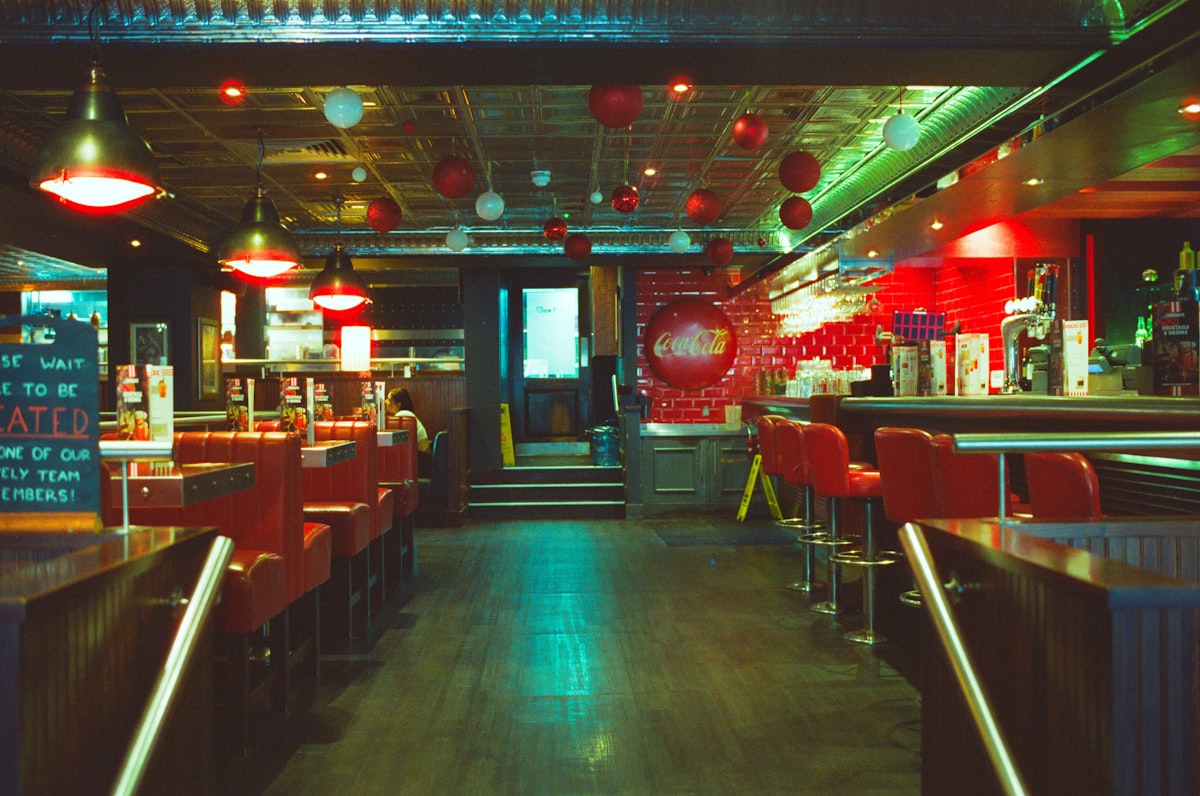
The sociologist Ray Oldenburg gave that place a name in 1989. The first place is home, the second is work, and the third place is everything in between: the cafe, the bar, the barbershop, the general store, the lodge, "the regular, voluntary, informal, and happily anticipated gatherings of individuals beyond the realms of home and work." You do not go there to accomplish anything. That is the point of it. And by most counts, there are fewer of them every year. Bowling alleys, the tired old emblem, are down about 32 percent since 2005, by IBISWorld's count of the businesses; the Census Bureau's establishment series traces the longer fall, from 6,148 with paid staff in 1986 to 3,154 in 2023. Robert Putnam saw the leagues collapsing thirty years ago, 40 percent fewer league bowlers between 1980 and 1993 even as the raw number of bowlers rose. Church membership fell below half the country for the first time in 2020, down from 70 percent in 1999. The venues that used to manufacture friendship without anyone deciding to are quietly going out of business.
Here is where the story stops being about all of us and starts being about the map. The loss is not spread evenly, and it never is. When researchers at CU Boulder ran the national business records tract by tract, they found the closures falling hardest on the places with the least to spare. Majority-Black areas had fewer libraries; rural and lower-education areas had fewer civic and social organizations. An earlier study had already mapped the broader direction, that the poorer the neighborhood, the fewer third places it holds to begin with. The places with the least to lose lost the most. That is my reading of it, not a number either study puts a coefficient on. The comfortable neighborhood keeps its coffee shop and its gym and calls the result a lifestyle; the poor one loses its one meeting hall and does not get another.
The difference is not cosmetic. In the summer of 1995 a heat wave killed more than 700 people in Chicago, and the sociologist Eric Klinenberg spent years working out why two adjacent, equally poor neighborhoods buried such unequal numbers of them. North Lawndale, with its empty lots and shuttered storefronts, lost far more of its residents than Little Village next door, where the sidewalks were still busy and there were still places to walk to. A disaster only reveals a class map that was already drawn. Klinenberg's word for the thing that saved lives is social infrastructure, "the physical places and organizations that shape the way people interact," and his favorite example of it is the plainest one there is: the public library, the space his book titles a palace for the people, after the 1,689 that Andrew Carnegie funded across the United States.

That is the modest, proximate answer everyone reaches for, and it is a good one. A library asks nothing of you, costs nothing, checks no membership, and lets an old man and a teenager sit in the same warm room for an afternoon. It is the closest thing we have to a third place that cannot be priced out. The catch is which kind of closing it is. The Boulder researchers draw a hard line between a place that closes from a shock and a place that closes from decline. The first kind reopens when the economy turns. The second kind, killed by a shrinking population or an investment that stopped coming, tends to stay dead, and it is the second kind that empties out the rural county and the disinvested block. The library works best exactly where it is least likely to still be standing.
The stakes are not soft. The Surgeon General put a number on loneliness in 2023 that reads like a provocation and is not: the mortality risk of social disconnection is comparable to smoking up to 15 cigarettes a day. By 2021, the Survey Center on American Life found that 49 percent of American adults reported having three or fewer close friends, up from 27 percent in 1990. You can read those figures as a summons to try harder, to text the friend, to host the dinner, and you should. But a friendship needs a where, and you cannot individually opt back into a place that has closed. The self-help version of this story asks you to be less lonely. The honest version asks who is going to pay to keep the lights on in the room where you would have stopped being lonely, and whether they will bother in the neighborhoods that need the room the most.