Only 21 percent of young single Americans now name a dating app as their main way of meeting people. Ask what that does to a stock price.
The figure comes from a nationally representative survey of 2,000 single American adults that the Kinsey Institute ran with DatingAdvice.com in May 2025. Among the Gen Z respondents, 21.2 percent named apps as their primary way of connecting, while 58 percent said they were focused on meeting people in person. Justin Lehmiller, the senior Kinsey research fellow who led it, put the finding plainly: "For a generation raised on technology, most of them don't actually seem to want to use technology to find love, and prefer to find it the old-fashioned way instead." A Forbes Health survey that summer found more than half of American Gen Z feel burned out often or always while using the apps, the highest rate of any age group.
So they are leaving. And the standard way to tell this story is as a moral victory: a generation gets tired of being a product, deletes the app, and finds something realer at a run club, where the interaction is direct and nobody is a curated grid of photographs. That story is not wrong. It is just not the whole ledger, and the interesting part is what the money is doing while everyone talks about authenticity.
The apps are not dying. They are shrinking on purpose and charging the survivors more. In the first quarter of 2026, Match Group, which owns Tinder and Hinge, reported that its paying users had fallen 5 percent from a year earlier, to 13.5 million, while revenue per payer rose 10 percent, to $20.90. Bumble told the same story louder: paying users down 21 percent to 3.2 million, and net earnings up 165 percent to $52.6 million, the best net margin in its public history, achieved mainly by cutting the marketing that used to chase those users in the first place. Its CEO, Whitney Wolfe Herd, described taking deliberate steps to "reset the Bumble member base" toward higher-quality members. When a company describes losing a fifth of its paying customers as a strategy, believe the accounting, not the adjective. This is a business harvesting a shrinking base, not a funeral.
And the same companies are already following the crowd out the door. Match Group's CEO, Spencer Rascoff, told investors that Gen Z wants lower-pressure connection and that the company is "embracing this trend of meeting people IRL in different modalities rather than hiding from it." Tinder is building in-person events; its Double Date feature was used by about a quarter of American women aged 18 to 22 in the first quarter. Bumble's fastest-growing corner is BFF, its friend-finding app, where group joins nearly doubled between December and March. The market for meeting in person is not being abandoned by the platforms. They are rebuilding it inside their own apps.
Which brings us to the actual winner of the offline summer, a company most people do not file under dating at all. Strava's twelfth annual Year in Sport report, drawn from more than 180 million users in over 185 countries and a global survey of 30,000 people, reads like a prospectus for the trend. New clubs on the platform nearly quadrupled in 2025, to around a million, and running clubs grew three and a half times. In that survey, which spanned users worldwide, 64 percent of Gen Z globally said they would rather spend money on gear than on a date, and Gen Z were 39 percent more likely than Gen X to use fitness to meet people who share their interests; 46 percent said yes to a workout first date. The company is valued at about $2.2 billion, and its CEO, Michael Martin, has said out loud that it intends to go public. His favorite data point is that more than half of Gen Z plan to use Strava more in 2026 while using Instagram and TikTok the same or less. That is not a wellness observation. That is a growth story, and someone is going to sell it to the market.
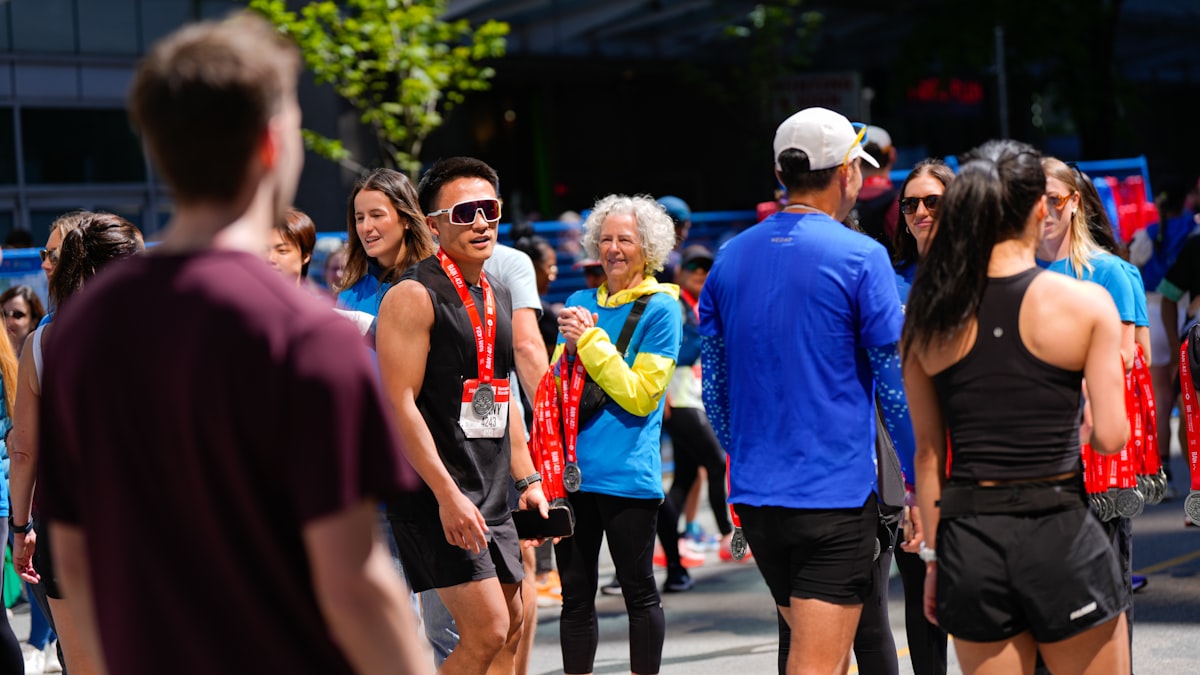
The run club itself is a genuinely good invention, and I do not want to sneer at a thing that works. In the United States, the format has hardened into a ritual. The Boston Globe reported that on Wednesday evenings more than a hundred people meet at City Hall Plaza for a three-mile, roughly five-kilometer run or a mile-and-a-half walk, and that the unattached wear black shirts so the rest can read availability at a glance. There it is: the legible, low-friction signal that the apps promised and then buried under an infinite deck. You can see who is available across a plaza. That is a real improvement on a feed.
But "free to run" is the phrase doing the quiet work, and it is not free. It presupposes the gear, which Gen Z's own confession, that they would sooner buy shoes than dinner, has already priced. It presupposes discretionary hours at six in the morning or seven at night, which shift workers and people with a second job and single parents do not have. It presupposes a body that runs three miles without pain, which is its own inheritance. And it presupposes a neighborhood with a coffee shop to gather outside of, a safe route, and a crowd you would want to be sorted into. The singles bar had a cover charge you could see on a sign by the door. The run club's cover is baked into who is able to show up at all, which is why I read it as the more effective sorting mechanism, not the more open one.
None of this means the swing is fake. Americans are lonelier than the apps could fix, and they have found each other in a way that involves weather and effort and the small intimacy of being out of breath next to a stranger. That is worth something the phone could not deliver. It is also, already, a market: a re-pricing at the incumbents, a growth story at Strava, an events line on Tinder's roadmap. The generation that got tired of being the product did not stop being the product. It just changed into activewear.