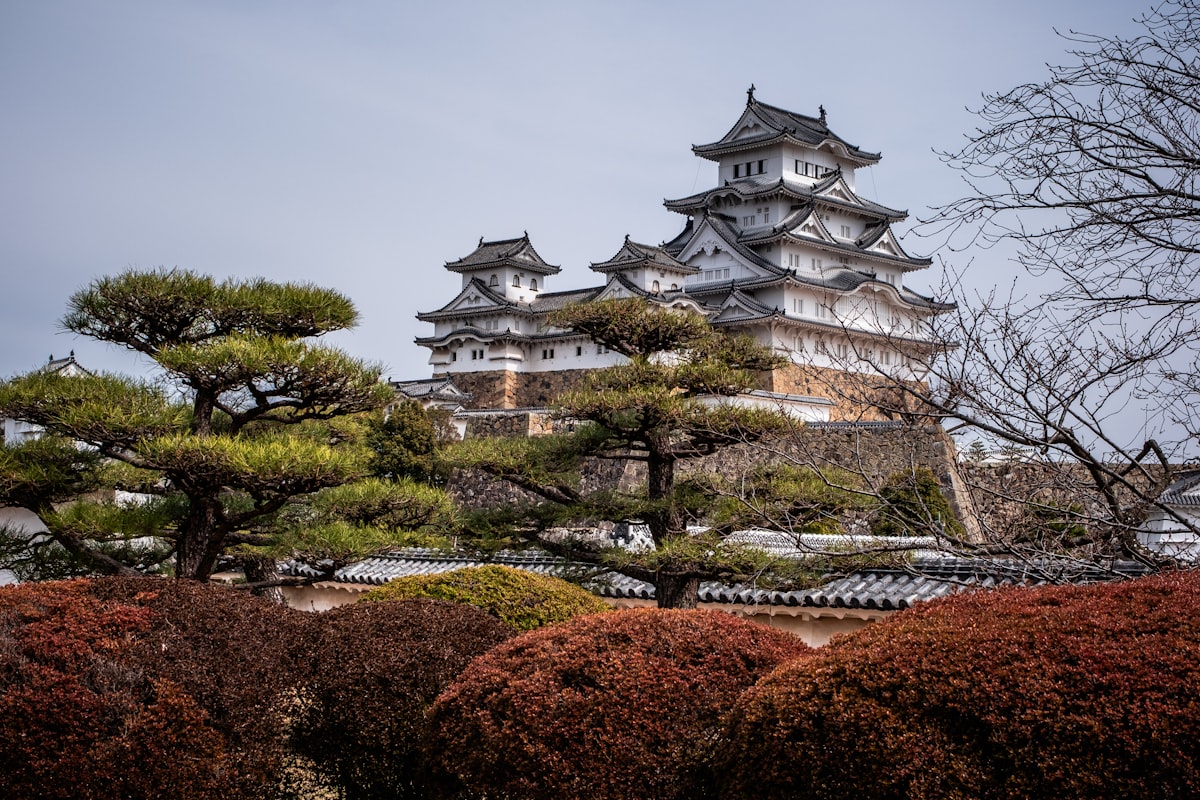
At the ticket window beneath Himeji Castle, the question is no longer how many of you there are and how old. Since March 1 it is where you live. Show a My Number card or a Himeji driver's license and the adult ticket is 1,000 yen. Everyone else pays 2,500, a tourist in from Osaka included. Children and teenagers now walk in free. The city's own notice spells out the mechanic plainly: residency is proven at the gate, or online with a My Number card for a digital ticket, and it decides which of two prices you pay.
Then look at what one month of it did. In March, admissions to Himeji Castle, the hilltop keep known as the White Heron for its white plaster walls, fell about 17 percent year on year, to roughly 140,000 people, while ticket revenue practically doubled, to around 270 million yen against about 135 million the previous March, Kyodo reported. The drop was more or less what the castle's management bureau had planned for. By the same reporting, the city now projects about 2.2 billion yen in ticket revenue for fiscal 2026, roughly a billion yen more than the year before, all of it earmarked for preservation of a nearly 400-year-old structure whose stone walls need seismic work. Fewer visitors, more money. That is the whole pitch, and it is why other places are copying it.
Himeji draws the line on residency, not nationality
It is being sold under a phrase that is not quite true. Call it dual pricing, call it charging foreigners more, and you have described the headline, not the rule. The castle's own bureau rejects the frame. "It's often reported as 'dual pricing,' but we see it as a flat 2,500 yen with a discount for city residents who show ID," Kensuke Tsushi of the management bureau told Kyodo. That is the honest core of the thing. At Himeji the line is drawn on residency, not nationality. A foreign national with a Japanese residence card pays the local rate. A Japanese tourist from Tokyo pays the tourist rate. The person who lives there and already funds the castle through city taxes is the one who gets the break, which is the version of two-tier pricing I will defend without much squirming.
I say that as someone who has argued for a decade that the fee is rarely the discrimination worth your outrage. Thailand's national parks charge a Thai forty baht and a foreigner up to four hundred at the busiest of them, Khao Yai and Maya Bay among them, and the number that should trouble you is not the four hundred but who owns the land beside the park, and whether the gate is paying to protect the place or quietly fencing it off. Himeji is answering a real bill. Overseas visitors to the city reached 547,000 last year, up from 387,000 in 2018, and, by Japan Travel's account of the change, upkeep that ran about 14.5 billion yen over the past decade is projected near 28 billion over the next. A castle worn by a record crowd, priced to be repaired by that crowd, is not the outrage. It is the reality.
The national museums go two-tier by 2031
The reason to pay attention now is that Himeji is no longer a one-off. Japan's Agency for Cultural Affairs is moving the national museums to dual pricing by 2031, a first for state-run institutions, and the guidance is to charge foreign tourists two to three times the citizen and foreign-resident rate. At the Tokyo National Museum that could lift regular admission from 1,000 yen to as much as 3,000. Again the higher rate is for nonresidents, not foreign nationals living in Japan, with the extra income aimed at tourist-facing things, more multilingual labels and audio guides, and at weaning museums that now cover barely half their costs off the taxpayer, toward a target of 65 percent self-funding within five years. The Japan Tourism Agency is expected to publish national guidelines by early 2027 so that the next town does not have to invent the scheme from scratch.
The resident discount is a line drawn where it is easiest to draw
The public is largely with it. A February survey by Loyalty Marketing, the company behind the Ponta point program, found over 60 percent of about 1,200 respondents in favor of separate pricing for tourists, with roughly 40 percent against, most of those citing discrimination and the harm to Japan's image abroad. That split is the argument in miniature, and both halves are reasonable. Not everyone in office agrees. Yuji Kuroiwa, the governor of Kanagawa, argued on Fuji TV's "The Prime," before Himeji ever changed its ticket, that foreign travelers are "our guests", that a visitor arriving in Kamakura from another prefecture pays no local taxes yet still uses the city's services, and that a surcharge amounts to "collecting a fine from them for coming to Japan." That Kamakura point is aimed straight at the tax logic I leaned on a moment ago: if a Japanese day-tripper uses a city's streets without paying its taxes and no one bills him for it, the resident discount looks less like a clean principle than a line drawn where it is easiest to draw, and Kuroiwa is right to press it. Lauren Kelly, a Briton based in Bangkok who travels to Japan often, told Kyodo the idea "feels quite segregating," while adding that Thailand, where she lives, is "a poorer country than Japan, so in a sense I think that would make it feel worse." Neither is wrong to feel it.
The test is where the money goes, and who gets sorted
Here is where my own record makes me cautious. I cheered the 2018 closure of Maya Bay as clean conservation, and it took me too long to see that high value and low impact is also a way to swap backpackers for yachts and hand a public shore to whoever can afford the timed slot. Protection and enclosure can wear the same uniform. So the question I now put to every two-tier site is not whether the tourist pays more, but where the money goes and who is quietly being sorted. Himeji passes: the money goes to stone walls and the sort is residency. Others are murkier. Niseko's ski resorts charge international visitors about 6,500 yen for a day pass against 5,000 for locals, and the stated aim, keeping Japanese skiers on their own slopes, is one crowd traded for another as much as it is upkeep. The new Junglia theme park in Okinawa gates by nationality outright, 8,800 yen for foreign tourists and 6,930 for residents.
The private sector is where the sort gets crude. In Shibuya a seafood buffet called Tamatebako charges tourists about a thousand yen more than residents, its owner Shogo Yonemitsu telling CNN that serving foreign diners is slower and costlier, and framing the gap as a discount for locals rather than a penalty on visitors: "People say it's discrimination, but it is really hard for us to serve foreigners." Tamatebako at least asks for proof of address, so the line it draws is documentary. The sharper worry, the one foreign residents keep raising, is about the places that will not bother with a card at all: critics of the Shibuya model asked how a restaurant is even supposed to tell a tourist from a local without either checking a document or reading a face. Surcharges like these are rare outliers, not policy. They are also the ones to watch, because they are the version with no earmark behind them and no residence card to check.
Budget for it, and ask if it pays for the roof or the view
For now, budget for it rather than fear it. If you hold a Japanese residence card, you generally pay the local rate at the public sites, card at the ready. As a visitor, the ones already in effect are short and specific. Himeji Castle runs 2,500 yen against 1,000 for residents; Odawara Castle, an easy stop on the Tokaido line, 1,000 against 500; Nanzoin Temple near Fukuoka asks 300 yen of overseas visitors and lets residents in free; the Blue Pond parking lot in Biei charges 500. Kyoto is weighing a city-bus fare that would sit around 350 to 400 yen for non-residents against 200 for locals, and Kiyomizu-dera, Fushimi Inari, and Nara's Todaiji are the temples most expected to follow. None of it will break a trip financed by a yen this weak. What it asks of you is smaller and older than a budget line: to notice that a place has decided the people who live inside the postcard should not be priced out of it, and to ask, at each gate, whether the surcharge is paying for the roof or just for the view.