The hardest part of the trip was supposed to be getting in. It was, instead, a bowl of bun rieu on Hang Bong at seven in the morning, the crab-and-tomato broth thin and sour and a little sweet, thirty-five thousand dong, and the woman ladling it telling me with her chin to move my bag off the second stool because someone was coming for it. The border I had braced for was a web form and a PDF. The counter was the thing that took some sitting with.
That inversion is the whole story of Vietnamese travel right now. Since August 2023, Vietnam's electronic visa has been open to citizens of every country and territory on the planet, valid up to ninety days, single or multiple entry, for twenty-five dollars single and fifty for multiple. You apply at evisa.gov.vn, the Immigration Department's own site, not one of the lookalikes that tack on a fee, and you enter through one of forty-two designated gates, which in practice means any international airport. The U.S. Embassy in Hanoi states the terms plainly, which is a useful tell: when the paperwork is boring enough that an embassy page can summarize it in a sentence, the friction is genuinely gone.
Access, it turns out, is a strategy, and it is working with almost embarrassing efficiency. Vietnam logged 10.6 million international arrivals in the first five months of 2026, the highest five-month figure on record and up 14.9 percent on the year, according to the National Statistics Office's own report on the period. May alone brought 1.78 million. That is 42 percent of the country's full-year target of 25 million, banked before the summer even started, a share the release credits to the National Authority of Tourism's reckoning. Air carried 8.7 million of them, better than four in five arrivals. The visa is not the only reason, but it is the reason with a decree number attached, Resolution 127, and it is the one the government can actually turn up or down at will.
Look at who is coming and the strategy reads clearly. Mainland China and South Korea together account for close to 40 percent of arrivals, the old reliable near markets. But the line that jumps is Russia, which has climbed to the third-largest source: by the first half of the year it had logged 742,700 arrivals, up 185.8 percent, per National Statistics Office figures carried in the state press. The statistics office's own report frames the wider run as resting on "a stable and safe socio-political environment" and "increasingly open visa policies," which is the polite official way of saying that when the wider map gets nervous, a place that is cheap, warm, and easy to enter collects the overflow. The money follows: accommodation and food services alone booked 400.4 trillion dong, about 15.2 billion dollars, in five months, the same report says.
Here is where a food writer earns his stool. A frictionless door does not scatter people. It concentrates them. Ten million visitors do not fan out evenly across a thousand miles of coastline; they land in the same handful of places they already saw on a screen, and the queue you skipped at immigration re-forms at the beach. Vietnam Coracle, the independent site that has mapped this country patiently for years, reports two-hour airport lines at Da Nang during its own fireworks festival, and says the poster city for the boom now gets compared to Bali or Phuket. The open door is real. So is the crush waiting on the other side of it.
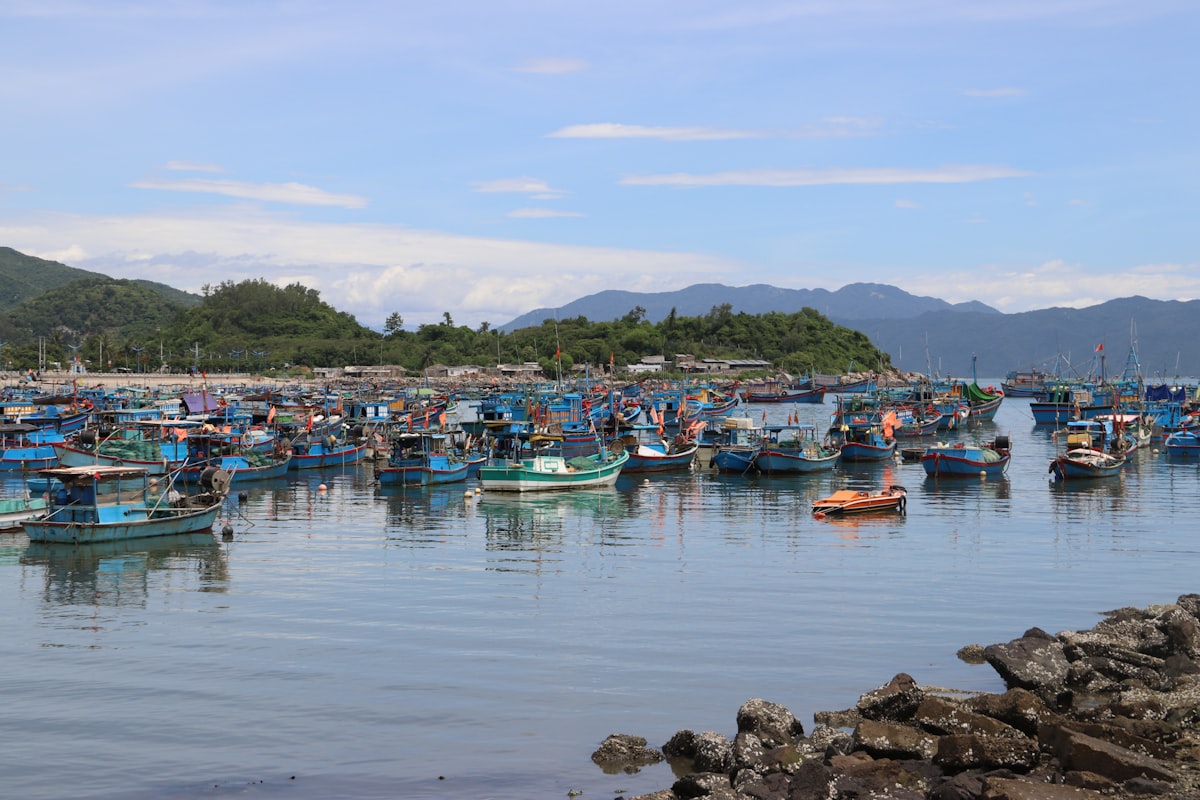
Which is an argument for going, and for going sideways. A hundred kilometers up the coast from Nha Trang sits Tuy Hoa, a working town of long public beach and grilled seafood and a night market that fires up near the train station, everything Nha Trang sells without the freight. Coracle sets Nha Trang's sand at more than ten million people a year against roughly thirty thousand international visitors for the whole province around Tuy Hoa, and though it cites no source, both ends check out against the provinces' own numbers. The thirty thousand is Phu Yen's 2024 international count, reported by the provincial tourism sector alongside nearly four million total visitors. Nha Trang's ten million, by contrast, is a total figure, domestic crowds included; its province, Khanh Hoa, served well over ten million visitors a year and drew some 4.8 million international arrivals in 2024 alone, by the state paper's account. It is not a clean like-for-like, but the gap it points at is real. Quy Nhon stays quiet for the plainest reason there is: no major international airport, so you arrive by the Reunification Express or not at all, and the twelfth-century Cham towers at Duong Long stand in an empty field while tour buses idle at the crowded Cham sanctuary at My Son. Even near Da Nang there is Lang Co under the Hai Van Pass, and An Bang outside Hoi An, where the crowd thins to slow travelers and people who came for the banh xeo.
I should be honest about the shape of my own advice, because "go before the crowds" is a sentence I distrust in other people's mouths and should distrust in mine. I am the crowd. I flew in on the same easy visa, I will write this down, and some of you will book Tuy Hoa because I did, which is how a quiet beach stops being one. The e-visa did not make Vietnam more authentic or less; it made it reachable, and reachable is a neutral fact that cuts both ways. What you do with ninety frictionless days is the only part still up to you. My suggestion is to spend as few of them as possible in a line, and as many as you can afford on a low stool where someone is waiting to take your seat back. That is where the country actually is, and it costs about thirty-five thousand dong.