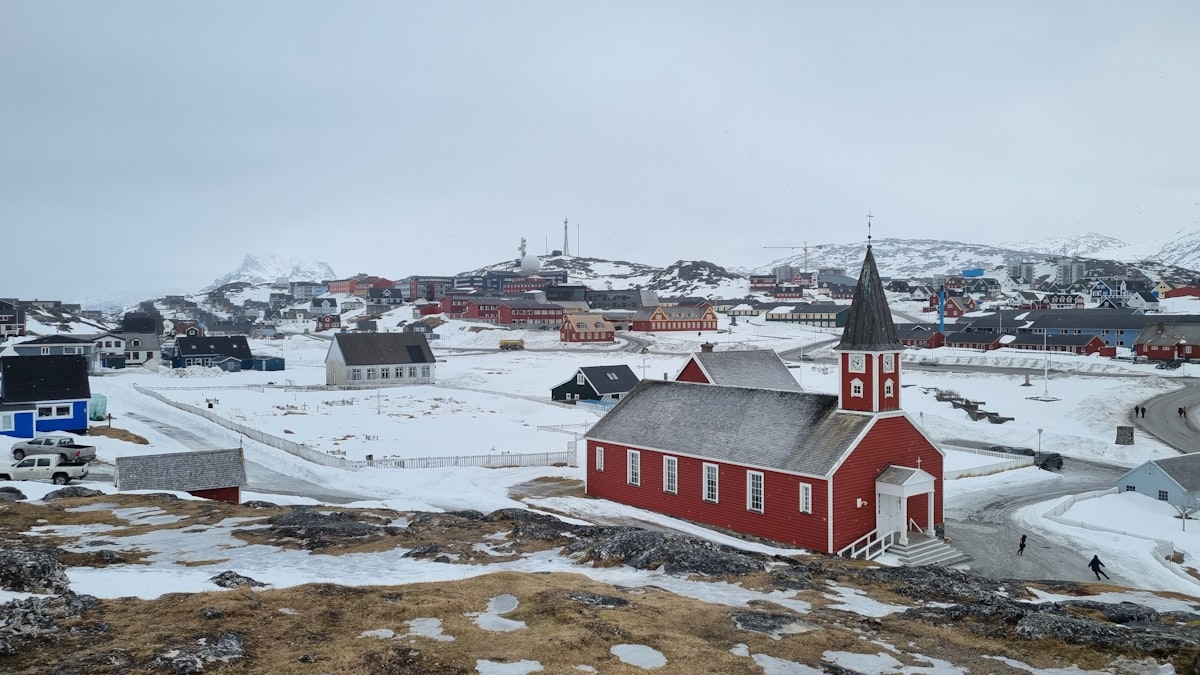
To make the capital reachable, Greenland blasted apart close to six million cubic meters of granite and gneiss, a volume the American Society of Civil Engineers has likened to a soccer field standing a kilometer and a half in the air. That is the figure that stays with me, because it is the honest measure of what an island does to put itself on a map: not a campaign, not a slogan, but a mountain taken apart and laid back down as a landing strip. The old runway at Nuuk was 950 meters, long enough for the propeller Dash-8s that had served the town for decades and nothing larger. The new one is 2,200 meters, and on November 28, 2024, an Air Greenland A330neo named Tuukkaq, which the airline glosses as the head of a harpoon, came down on it from Copenhagen, the first wide-body ever to land in the city. A place that had been hard to reach on purpose, or at least by default, had decided to be easy.
I have not walked Nuuk. I write this from other people's reporting, which is the only honest way to say it, and from a distance I know well, having watched smaller versions of what is about to happen there. What the reporting describes is not a discovery. It is a construction project with a policy attached, and the policy is the part worth reading closely, because Greenland is doing the rare thing of trying to author its own arrival rather than wait to be authored by it.
The scale of the bet
Nuuk was only the first of three. Qaqortoq, in the south, opened its 1,500-meter runway on April 16 this year, giving the town its own field in place of a heliport and taking over, in practice, from Narsarsuaq, the airport that had served the south for decades and closed to fixed-wing traffic the day after Qaqortoq opened. The opening was rougher than the ribbon suggested: for a time the field stayed closed to all fixed-wing traffic except Air Greenland and the military, its apron control not yet signed off by the aviation authority, its aviation fuel unavailable after the fuel truck was damaged in transit. Ilulissat, up on Disko Bay where the icebergs calve, gets the last and largest of the three on October 29, a 2,200-meter runway matching Nuuk's, though it has run over budget badly enough to need a further 400 million Danish kroner from Copenhagen plus a loan extension larger still. Three runways in under two years, in a country of roughly 56,000 people, about 20,000 of whom live in Nuuk. The scale of the bet against the size of the population is the first thing to hold in your head.
The traffic, and the free publicity
The traffic is already arriving to meet it. United now flies the only direct link between the United States and Greenland, Newark to Nuuk, a route it opened in the summer of 2025 and resumed this year on June 7, twice a week through September 23 on a 166-seat Boeing 737 MAX 8. The original announcement had said June 13; it moved earlier, which is the kind of small correction worth making because the whole story is prone to rounding up. In its first season the route carried a little over 6,200 passengers, by the airport authority's own count, across 58 flights. Air Greenland runs the Copenhagen link, up to eight times a week in summer, and Icelandair threads people through Reykjavik. And the search graphs, which are not arrivals but are the leading edge of them, have gone vertical: the hiking operator Inghams Walking, ranking more than two hundred cool-climate destinations, put Nuuk first for the summer, on a 48 percent rise in searches over the year, with its head of destinations, Laura Mason, tying it to the same heat-flight north that has made "coolcation" a word. Take the number for what it is, a tour company measuring curiosity, not a ministry counting beds slept in. But curiosity is what fills the runways.
Some of the curiosity was bought for Greenland at no charge. When US President Donald Trump revived his interest in acquiring the island, the coverage that followed did for it what an eruption once did for Iceland. Operators said so on the record. Lars Anker-Moller, who runs the adventure company Arctic Dream in the east, told the Associated Press his bookings rose close to 60 percent and put it plainly: "The whole world knows now where Greenland is, and before nobody knew." He compared it to the tourism Iceland won after its 2010 volcanic eruption. The attention cut both ways, though, and the same AP account noted that when Trump raised the prospect of taking the island by force, bookings briefly ground to a halt and some travelers canceled. The national tourist board, for its part, leaned into the moment with a campaign called Shhhh, selling the place as a sanctuary from exactly that noise. Attention is not a strategy, and this attention came with a claim on the island attached to it, but it did the work of a decade of marketing in a season.
A second industry, and a law to hold it
Here is why a country would want any of this badly enough to move a mountain for it. Greenland's economy is a single industry with a subsidy behind it. Fish, mostly cold-water shrimp and halibut, are close to 90 percent of what it exports. The annual block grant from Denmark still covers around half of government revenue. Every conversation about tourism in Greenland is, underneath, a conversation about independence, about whether a second industry can be grown fast enough to loosen the grip of the first and of Copenhagen both. Tourism is the most plausible candidate, because the island has the one thing that does not deplete when you sell it, which is itself.
That is precisely the trap, and Greenland appears to have watched enough other places fall into it to legislate against it in advance. On January 1, 2025, its first tourism law came into force, and it is not a marketing document. It requires that companies offering tours be registered and taxed in Greenland, and that at least two-thirds of a firm's capital be locally owned. It licenses the guides and the excursions, exempting only the smallest operators, and it layers taxes onto the cruise ships, whose passengers had climbed from under 8,000 a decade ago to more than 50,000, and who are the least anchored visitors of all because they sleep and spend on the ship and leave a wake instead of a wage. The government framed the law in terms it did not have to use. In an English rendering of its stated aims, sustainability "is not only about the environment," it is "about ensuring that it is the Greenlandic people that control their own future." Two-thirds. That fraction is the whole argument. It is a country saying that its icebergs may be photographed by anyone but will be sold, at least in majority, only by the people who live under them.
The rooms that do not exist yet
I have watched what happens where no such fraction is written down. A bakery I once described in Istanbul became a queue, then a brand, then a shuttered front. An Armenian quarter I love across the river from where I live is being remade faster than anyone can record it, the ownership moving quietly out of local hands one lease at a time. So I read Greenland's two-thirds with something close to hope, and I distrust the hope, because I once wrote in a guidebook that my mother's town on the Black Sea was too poor to spoil, and within five years it had a skyline of casinos. I will not tell you the law will hold. I will only note that most places never even tried to write one.
And laws do not build hotel rooms. This is where the arrival is running ahead of itself. Bloomberg, drawing on a Visit Greenland count, put the capital's late-2024 capacity at 586 hotel beds, another 357 in serviced apartments, and 96 in hostels, with nothing new opened for the 2025 season to add to them. When the first summer of direct flights arrived, travelers were stranded without rooms, and Air Greenland set up makeshift hostels inside the airports to hold the overflow. A night at the Hans Egede, the capital's best hotel and a modest one by the world's standards, runs past 350 dollars in season. By the same reporting, in August the Nuuk airport itself briefly shut down when its security screening was judged insufficient under Danish transport standards, and a United flight out of Newark with more than a hundred people aboard turned around in the air and went home. A country can move six million cubic meters of rock in five years. It cannot conjure a bed the night the plane lands.
So Greenland arrives at its own doorstep this summer with the runways mostly built, the rules mostly written, and the rooms mostly not, which is roughly the order in which these things always come and exactly the wrong one. The record is already set: by Bloomberg's account, 2025 brought close to twice the international arrivals of the year before. The question the reporting cannot answer, and that I will not pretend to, is whether a place can hold onto itself while inviting the world to land on it twice a week. The airport cots are folded and stacked somewhere in Nuuk, ready for the nights the rooms run short.