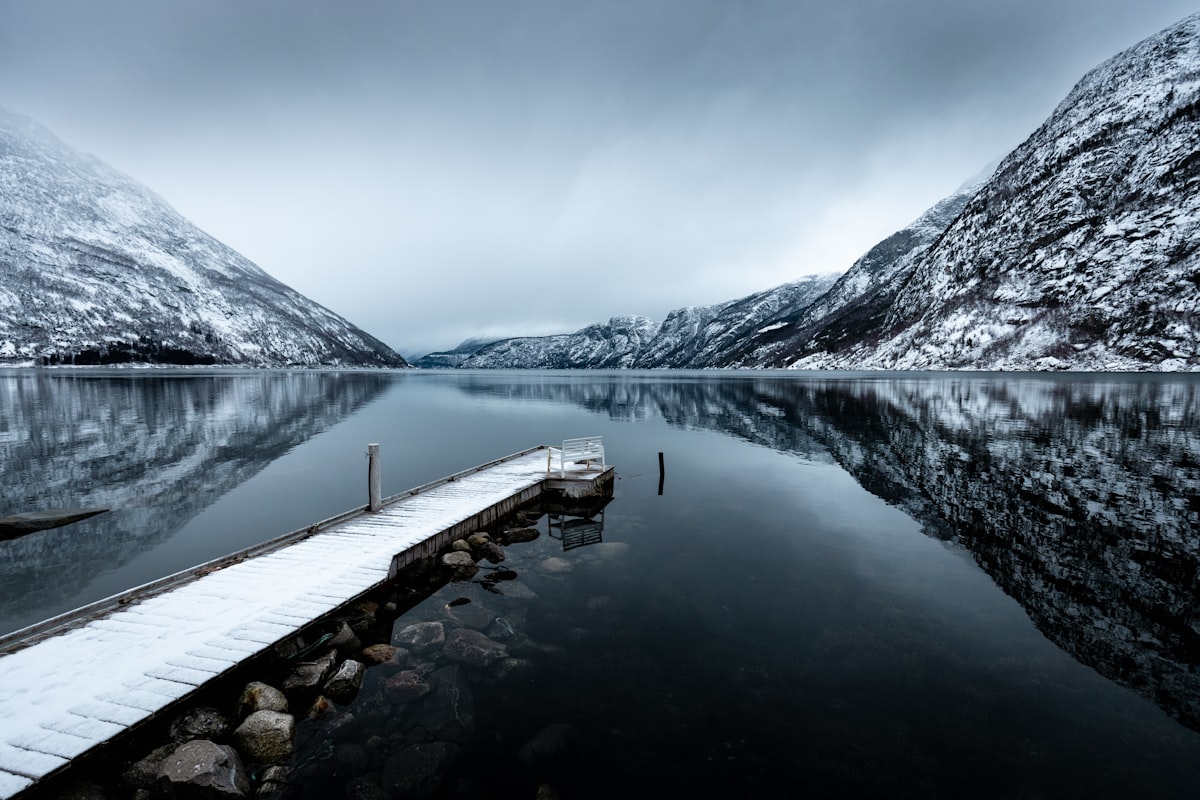
It is late July in Tromso, in northern Norway, and the nights still have not gone properly dark. That ends in August, and by September the drift has set in: bedtime slides later, mornings get heavier. The advice that arrives with it is a screen curfew. The better bet, on the light that has actually been measured on people, is the daytime end, and most likely the first hour after you wake.
Start a little south of here. Lowden and colleagues, in Clocks & Sleep, followed 32 day-shift workers in Kiruna, in Swedish Lapland, through summer and winter. Their midday light exposure peaked around 1,900 lux in summer and at 109 lux in winter. Sleep onset ran 39 minutes later in winter, they slept 12 minutes less, and in both seasons the ones getting more morning light slept earlier. One caveat covers every field number here: they are wrist-worn readings, which correlate poorly with the light reaching the eye.
A modeling paper published in April, in the same journal, asks what that morning light is doing. Tavella and colleagues ran a mathematical model of the human clock rather than an experiment on people. They disclose their affiliations: two of the four work at Arcascope, which sells an app that tells people when to get their light, and one of them, Olivia Walch, is its chief executive as well as a researcher in the University of Michigan's neurology department; a third is at the sleep-tracking company Sleep Cycle, and the fourth is at Stanford.
They put an hour of 5,000 lux at three points in a simulated day: on waking, 7 hours later, and 14 hours later. Light on waking pulled the clock earlier, light in the middle of the day barely moved its timing, and light 14 hours in pushed it later. Against a dim 100 lux background, the simulated sleeper who got the light on waking went to bed about 52 minutes earlier than the one who got it midday. A bright day, they argue, leaves the clock harder for evening light to shift, or in their words, "robust daytime light exposure confers resilience against the circadian-disruptive effects of evening light."
Models are models, and this one has a specific hole. Consider the 2015 eReader experiment the paper set out to reproduce. That study put 12 adults on a sleep ward and found they took about 10 minutes longer to fall asleep after an evening reading a screen. The model came out at 14.5 minutes against a dim 90 lux day, overshooting by almost half, which is a loose match to call a match. The number that matters is the next one: that delay fell to about 5 minutes once the simulated daytime light rose to 500 lux. What the model could not reproduce was the same study's melatonin result, a shift of more than an hour and a half, which it managed only when the eBook came first and then only for a limited set of parameters.
The largest human dataset points the same way, with two qualifications. Dunster and colleagues, in the Journal of Pineal Research, tracked more than 500 students in Seattle across four seasons. On winter school days they fell asleep 35 minutes later and woke 27 minutes later than on summer ones. Each extra hour of daytime light went with a clock about 30 minutes earlier, while each extra hour of light after dusk went with one only 15 minutes later. But this is a snapshot across a population, not an experiment, so it shows what travels together rather than what moves what, and the measure was daytime light in total, not morning light in particular. For morning light specifically you are leaning on the model and on that one Kiruna correlation.
The autumn end is thinnest of all. When 19 students at the University of Surrey, in England, were measured in late autumn and again in late spring, reported in Frontiers in Neuroscience, their peak light exposure ran about 600 lux in spring against 200 in autumn, and a model fed their real light explained their spring sleep timing well but fell short in autumn, the season everybody is asking about. Morning light is a lever, not a cure.
So, going into September: outside within the first hour of being awake, before the desk. The daylight leg of the commute rather than the subway platform. The Seattle team counted anything above 50 lux as daytime light, a low bar that stepping outdoors clears easily. An expert consensus in PLOS Biology works in a different measure altogether, daylight-equivalent light at the eye, and asks for 250 lux of that; every field reading above is plain lux off a wrist.
If your morning is dark, a light box is the substitute, used on the same schedule. All of this describes ordinary seasonal drift in people who otherwise sleep normally; sleep trouble that does not track the seasons, or a mood that comes with it, is a clinician's question. What these studies measured was timing, not how awake anyone felt. You are not chasing the feeling of being awake. You are telling a clock what time it is.
And then the argument runs out. From late November to the middle of January the sun does not clear the horizon here at all, and the mountains hold it off the center of town until around January 21. On those mornings my walk gets me a fraction of what it gets me now, and the box on the shelf goes on at the same hour instead.