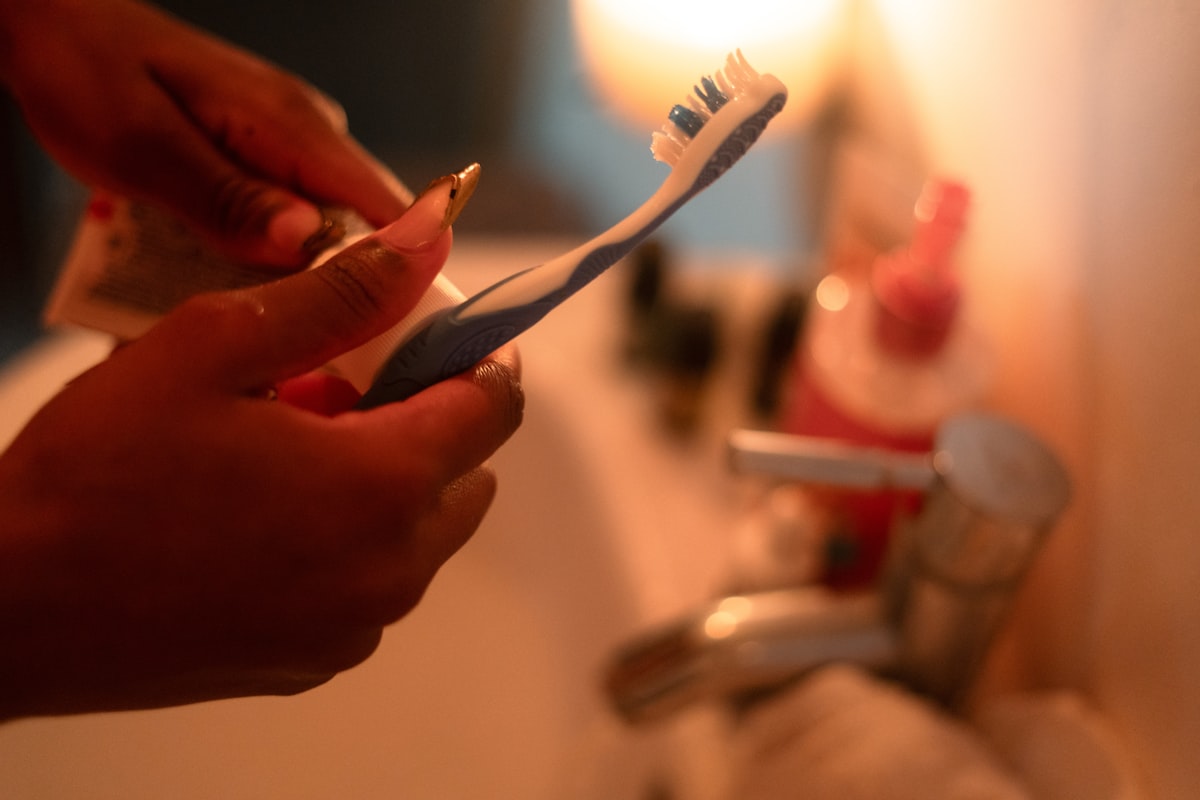
Titanium dioxide has not been legal in an EU bowl of cereal, a scoop of ice cream, or a slice of processed cheese since August 7, 2022. It is still legal, today, in the paste you use to brush your teeth after eating any of them.
The ingredient is the same compound either way: CI 77891, the whitener that gives toothpaste its familiar white color and gives many lipsticks and lip balms their opacity. The reason it survived in your bathroom cabinet while it disappeared from your pantry is not that cosmetics regulators found it safe. It is that they are answering a narrower question, and that answer is still open.
Food left first because of a 2021 opinion from the European Food Safety Authority that could not rule out genotoxicity, meaning a possible risk of DNA or chromosomal damage, in titanium dioxide as the food additive E171. That was enough: under EU food law, being unable to confirm safety is grounds to pull an additive, not a requirement to prove harm. The European Commission banned E171 from food outright under Regulation (EU) 2022/63, phased in from February 2022 to a full ban that August, with only medicines carved out while replacements are found.
Cosmetics run on a different standard, and the EU's Scientific Committee on Consumer Safety (SCCS) has said so explicitly. Asked in 2022 to redo its own risk assessment on titanium dioxide in toothpaste, lipstick, lip balm, loose powder, and hairspray, the SCCS published its final advice in May 2024 after reviewing 84 distinct grades of the ingredient, 44 pigmentary and 40 nano. Only two nano grades, labeled RM09 and RM11, had genotoxicity data clean enough to clear. For essentially everything else on that list, including the pigmentary grades that fill most toothpaste tubes and some of which are more than half nano-sized particles by the SCCS's own account, the committee said the evidence was not sufficient to rule out genotoxicity. Not proof of harm. Not proof of safety either. The committee's reasoning for not pulling the ingredient anyway is that a cosmetic is not swallowed on purpose, so unintended oral exposure from brushing or wearing lipstick is assumed to be small. That assumption, not new toxicology, is the entire gap between your toothpaste and your cereal box.
Industry submitted a new safety dossier in June 2025 to address the gaps the SCCS flagged. The European Commission responded with a fresh mandate in September 2025, asking the committee three direct questions: given the new dossier, is titanium dioxide safe in oral cosmetics as actually used; if not, can safe concentration limits be set by product category; and does the new data change anything else. That opinion is due by the end of 2026.
A parallel track adds pressure without settling anything yet. Titanium dioxide's separate EU hazard classification, unrelated to cosmetics, is a 2020 carcinogen label for certain powder forms that the EU's General Court struck down in 2022, ruling that regulators had relied on flawed evidence; the Court of Justice upheld that annulment on appeal in August 2025. Nine months later, in May 2026, the Czech Republic notified EU chemical regulators of its intention to file a new harmonized classification proposal for the same substance. What hazard it will argue for is not yet public. It does not bind the SCCS's cosmetics opinion, but it lands in the same year as that opinion and keeps titanium dioxide's file open on two fronts at once.
None of this means the toothpaste in your bathroom is doing anything to you. It means the EU asked its own scientists a specific question in 2022, got an honest acknowledgment in 2024 that the risk could not be ruled out, and is waiting on a more targeted answer before the end of 2026. Several non-EU regulators reviewing the same underlying data on food-grade TiO2 did not reach the same conclusion as the EU, so this is a live scientific disagreement, not a settled verdict dressed up as one. The honest position, until the SCCS reports, is that nobody currently knows the exact number worth worrying about, and anyone selling you certainty in either direction is selling, not reporting.