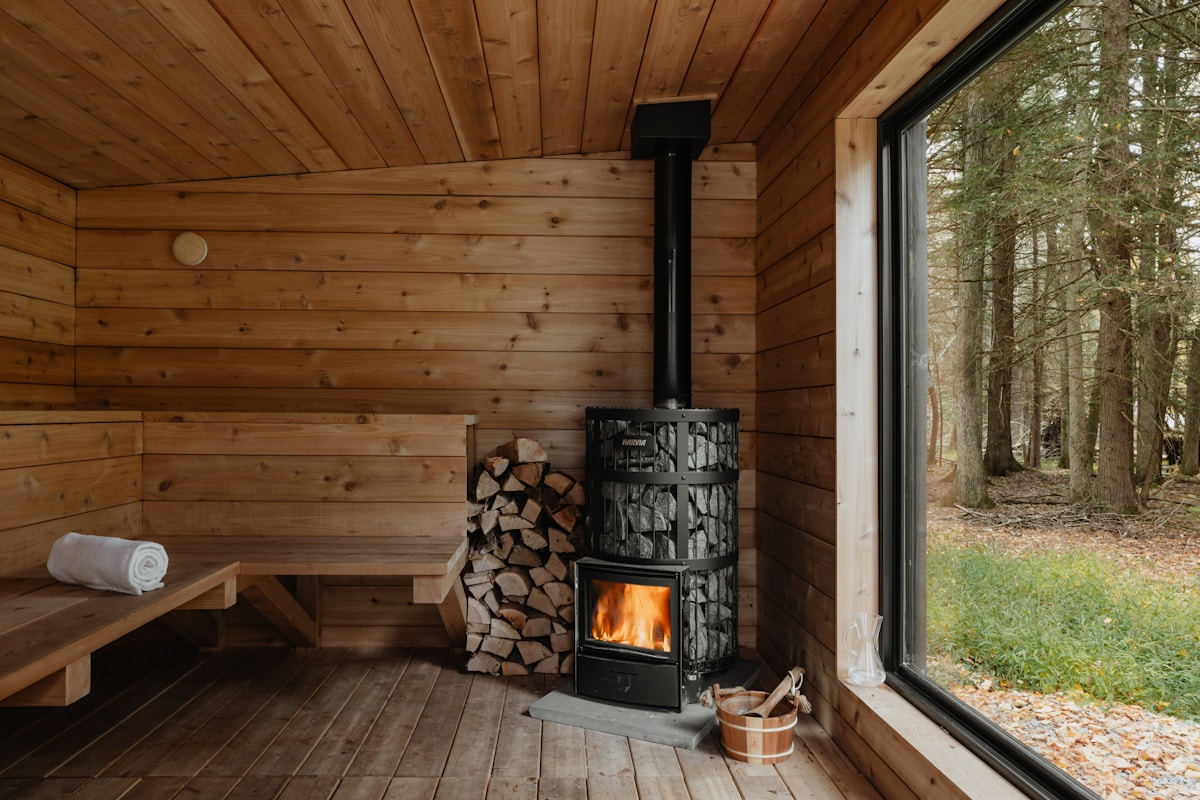
Put a heart rate monitor on someone sitting in a hot sauna and the number climbs toward what you would see on a brisk walk uphill. That is the fact this piece is built on: sitting still in heat is real cardiovascular work, closer to mild exercise than to rest. I come to the sauna from the cold end, the plunge into four-degree saltwater off the dock outside Tromso, where the hot room is the second half of the ritual. But the sea is not the point here, and you do not need one to follow along. The point is the room itself, the little wood-fired box, and the load it quietly puts on the heart while you do nothing at all.
That is the part people get wrong about a sauna. They file it under rest. You are sitting down, or lying on a bench, doing nothing, and it reads as the opposite of exercise. Your heart disagrees. In a moderate sauna the heart rate climbs toward 100 beats a minute, and in a hot one toward 150, which is the range you would hit at moderate to vigorous effort on your feet, and cardiac output can rise by 60 to 70 percent while roughly half to two-thirds of your circulation shifts out to the skin to shed heat. Those figures come from the physiology review by Rhonda Patrick and Teresa Johnson in Experimental Gerontology, pulling on older heat-chamber work. So the headline is close to literally true. It is cardiovascular work you can do lying down.
The cleanest test of that equivalence is a small German study by Sascha and Reinhard Ketelhut, published in Complementary Therapies in Medicine in 2019, that sat people in a sauna and then put them on a bike and compared the two. The cardiac load of the sauna corresponded to a dynamic exercise load of about 60 to 100 watts. And here is the honest wrinkle that gets sanded off in the wellness version: during the session itself, your blood pressure and heart rate go up, not down. The rate-pressure product, a proxy for how much oxygen the heart muscle is burning, rises. The famous drop in blood pressure comes afterward, and over months of repetition, not while you sit there. As a physiotherapist I like that the paper says this plainly, because it means a sauna is a stress test as much as a spa, and that matters for anyone whose heart is not stable. If your heart disease is unstable, uncontrolled, or symptomatic, ask a doctor before you use a sauna at all. What I am writing here is general information, not advice about your particular heart.
Finland's heaviest sauna users had far fewer cardiac deaths
Now the numbers that made everyone care. In the Kuopio Ischaemic Heart Disease study, a cohort of 2,315 middle-aged men in eastern Finland followed for a median of 20.7 years, Jari Laukkanen's group found that men who used the sauna four to seven times a week had a 63 percent lower risk of sudden cardiac death than men who went once a week, with a clean dose-response line through the middle, published in JAMA Internal Medicine in 2015. The hazard ratio was 0.37 (95 percent confidence interval 0.18 to 0.75), and the trend held for coronary disease, for cardiovascular death, for dying of anything at all. A later analysis extended the signal to women. Sit with that for a second. A 63 percent reduction is the kind of number a drug company would build a decade around.
The one clean trial in sick hearts came back empty
So why am I not telling you to build a sauna tomorrow and skip your run. Because I have read the trial that actually tested the mechanism, and it is the trial the enthusiastic writeups tend to skate past. In 2023, a Montreal group led by Amelie Debray and Daniel Gagnon ran a randomized controlled trial, published in the Journal of Applied Physiology, on 41 adults with stable coronary artery disease. Half of them did eight weeks of Finnish sauna, four sessions a week, twenty to thirty minutes at 79 degrees, which is a real dose. Then they measured the blood vessels directly: flow-mediated dilation, a gauge of how well the vessel walls relax and widen, pulse wave velocity, a measure of arterial stiffness, and blood pressure. Nothing improved. Flow-mediated dilation, no difference. Arterial stiffness, no difference. Systolic blood pressure, no difference. One secondary measure, forearm reactive hyperemia, actually shifted the wrong way for the sauna group. The sauna group did show heat acclimation, lower resting core temperature and better sweating, so the heat was landing. It just did not translate into the vascular improvement the observational studies had promised. The authors' own conclusion is that four sessions a week for eight weeks "does not improve markers of vascular health in adults with stable CAD."
That is the gap I keep returning to. The associations are enormous and the one clean interventional test in the people who would benefit most came back empty. Both things are true. The most likely reason is the oldest problem in this kind of research: the men in Kuopio who saunaed four to seven times a week were probably, in a hundred small ways, already the men who were going to live longer. Well enough to sit in the heat that often, settled enough in their week to have the time, and the statistics can adjust for the confounders they measured but not for the ones they did not. Frequent sauna use may be a marker of a life that protects the heart rather than the thing protecting it.
Sauna worked only bolted onto exercise, not instead of it
There is one interventional bright spot, and it is honest about its own shape. Earric Lee and Laukkanen ran a three-arm trial, in the American Journal of Physiology in 2022, on 47 sedentary adults with a heart-disease risk factor. The arm that got exercise followed by a fifteen-minute sauna dropped systolic pressure about 8 millimeters of mercury more than exercise alone, and gained more fitness. Which tells you the useful version of this: sauna appears to work best bolted onto the exercise, not standing in for it. No trial has shown that prescribing a sauna prevents a single heart attack or sudden death. That endpoint study does not exist yet.
"Just add sauna" assumes a life with room in it
I should name my own blind spot here, because it is a large one. A sauna is not universal. The entire Kuopio finding rests on a country where a sauna sits in most homes, which is exactly why the cohort was possible and exactly why it does not transfer cleanly to a reader in a flat with no such room. I build these things out of salvaged timber for other people, slowly, with opinions about the wood, and I know what one costs in money and space and hours. "Just add sauna" is the same easy sentence as "just go to the fjord," and it assumes a life that already has room in it. I try not to sell the room I happen to have as a thing you are failing to buy.
So here is where I would leave it, standing on the dock with the light going. Passive heat is genuine cardiovascular work, not rest, and that is the real and interesting fact. The long Finnish numbers are striking and worth taking seriously and are also observational, leaning hard on one cohort and one research group. The heat does honest work on the body, you can feel it doing it, and the strongest claim the evidence will actually support is smaller than the headline: a sauna is a fine thing to sit in, probably good for you, better still after you have moved, and not a substitute for the walk. If you have one, use it. If you do not, you have not been cheated of medicine. You have missed out on a very good warm room to sit in, which is a smaller and gentler kind of loss.
Disclosure: I build and sell wood-fired saunas commercially. Read my fondness for the room with that plainly in mind.