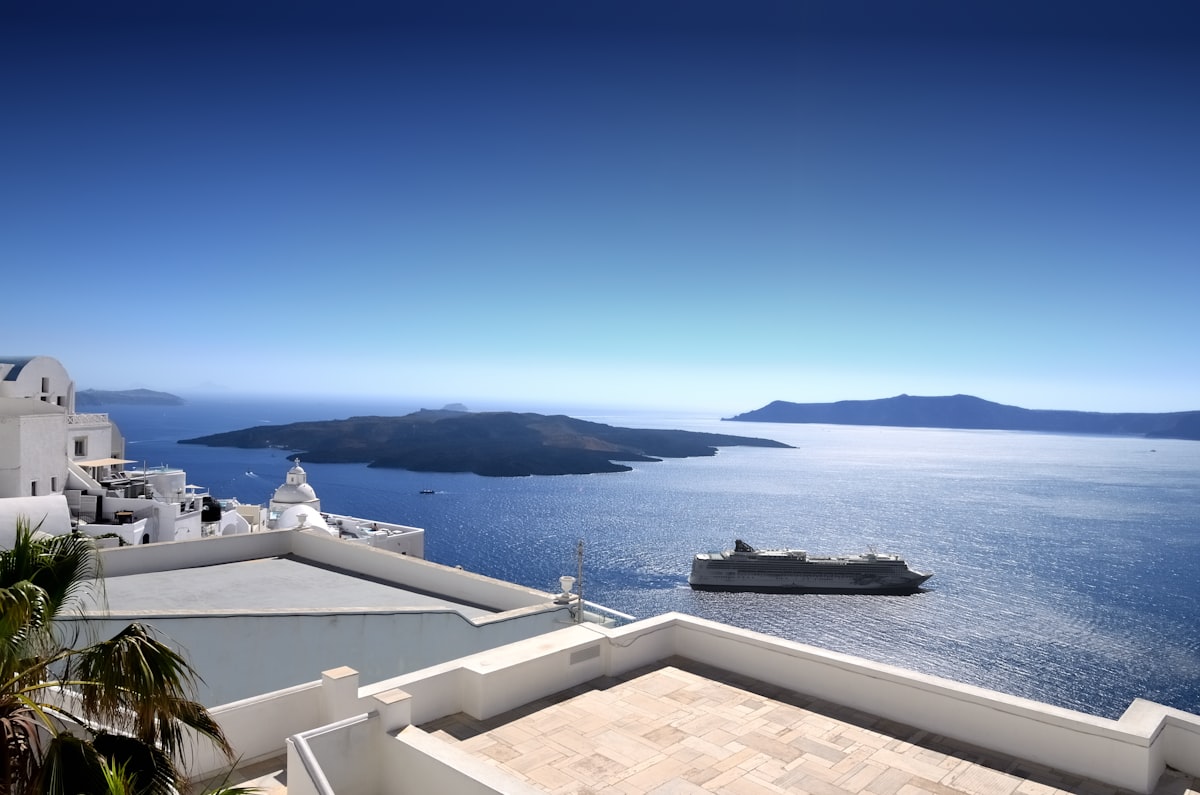
The charge lands the moment the cruise card is scanned at the gangway. Twenty euros to set foot on Santorini in high summer, per passenger, no discount for age. A family of four doing both Santorini and Mykonos at the top tier in a peak-season week pays at least 160 euros just to disembark. It is not a tax you forget you paid. It is a turnstile, and Greece built it on purpose.
Law 5162/2024, published in the government gazette as FEK A' 198, sets the levy in its Article 27 and calls it, in Athens's own words, a Sustainable Tourism Development Fee. Parliament passed it in December 2024; it took effect on July 21, 2025, delayed from July 1 after winter earthquakes thinned Santorini's early-season crowds. At Santorini and Mykonos it runs 20 euros a head at peak, June through September, 12 in the shoulder months, 4 in winter. Every other Greek port pays exactly a quarter of the island rate at each tier, 5 euros against 20 at the July peak, since the fee targets not the ship but the two islands whose names sell the cruise.
Santorini pairs the levy with a harder cap. Since 2025 the island has held cruise arrivals to 8,000 a day, a ceiling drawn from a 2018 University of the Aegean carrying-capacity study the Municipality of Thira commissioned and has reaffirmed each season since rather than merely inherited. A ranked berth-allocation system run by the Municipal Port Fund of Thira enforces it, bumping lower-ranked calls when a date fills. Greek City Times reports the port tightened the numbers for 2026, counting each ship at 100 percent of its berths rather than the 80 percent it assumed in 2025, so a 3,000-passenger vessel now fills 3,000 of the 8,000 slots. Scheduled 2026 arrivals are down about 18 percent, 595 ships against 728. On an island of roughly 15,500 residents that took in 3.4 million visitors and 800 cruise ships in 2023, with single days that hit 11,000 cruise passengers and, by the municipality's count, as many as 15,000, this is not a small correction.
The turnstile catches only the cheap crowd
I have argued for these tools before, so let me be honest about what nags. The cap and the levy fall on cruise arrivals only. Ferry and air arrivals face no limit, and the independent traveler with a hotel booking is untouched. Greece has selected against one segment: the ship passenger who steps ashore for a few hours, buys a coffee and a magnet, and leaves the crowding and the wastewater without the overnight spend. That segment skews older and thriftier, the retiree couple on a Mediterranean loop, easiest to price out. This is the Maya Bay lesson in Greek clothes, the Thai cove that closed to visitors in 2018 and reopened, capped and ticketed, to a smaller and wealthier crowd. "High value, low impact" is a fine conservation slogan and also a way to swap the cheap crowd for the expensive one and call it an ecological win.
The government's own framing gives the game away. Announcing the levy in September 2024, Prime Minister Kyriakos Mitsotakis said, in remarks the wires rendered from Greek, "Greece does not have a structural overtourism problem," adding that "some of its destinations have a significant issue during certain weeks or months of the year, which we need to deal with." It narrows the blame to a few islands and a few weeks, the frame that lets the day-tripper carry the weight.
Follow the money and it gets murkier. Greece's 2025 draft budget projected the levy would raise about 50 million euros a year, the budget line closer to 52, for pier extensions, shore power, and wastewater plants. But the take splits three ways: the Ministry of the Interior, which passes a third to the port municipalities, the Ministry of Maritime Affairs, and the Ministry of Tourism. The island's share reaches it through Athens rather than landing on the island. Santorini's mayor, Nikos Zorzos, has said as much: "Our view is that these funds should be directed to local government for the implementation of infrastructure projects, as we have repeatedly emphasized," he told Greek Reporter in April, also rendered from the Greek. The crowding is local. The check, mostly, is not. The fee lands on the passenger; the line keeps its margin and remits quarterly through a central platform, no threat to its business.
Amsterdam runs the same play with a blunter instrument. A 2024 council decision cuts sea cruise calls from 190 a year to 100 in 2026, roughly one ship a day, with shore power required from 2027. Transit passengers who moor without starting or ending a trip there pay a day tax that DutchNews reports rises to 15 euros in 2026, though the Port of Amsterdam's own schedule still lists 14.50. The council now prefers ending ocean cruises altogether by 2035 over the 85 million euros to relocate the terminal, leaving the decision to the government that forms after the March elections. A D66 councillor, Rob Hofland, called the ships "floating apartment blocks" that bring "hordes of tourists into our city," in words translated from the Dutch. Across Europe the cruise passenger has become the tourist it is safe to say you do not want.
The crowd moved to Crete, it did not shrink
Be careful crediting the caps too fast. Santorini's 2025 slump arrived alongside an earthquake swarm and thinner airline capacity, and you cannot cleanly separate which lever moved the numbers. The traffic did not vanish, either: Chania, on Crete, logged 408,946 cruise arrivals across two ports in 2025 by the Port Fund's count, up about 43 percent on 2024, which is what a cap looks like from the receiving end. Displacement is not reduction.
I defend the turnstile and still ask what it is built to avoid. The day-tripper is the guest you can meter at the gangway, blame in a headline, and price toward the next island without touching who owns the caldera-view land or where the 50 million goes. Those are the harder questions, and they do not fit on a cruise card.